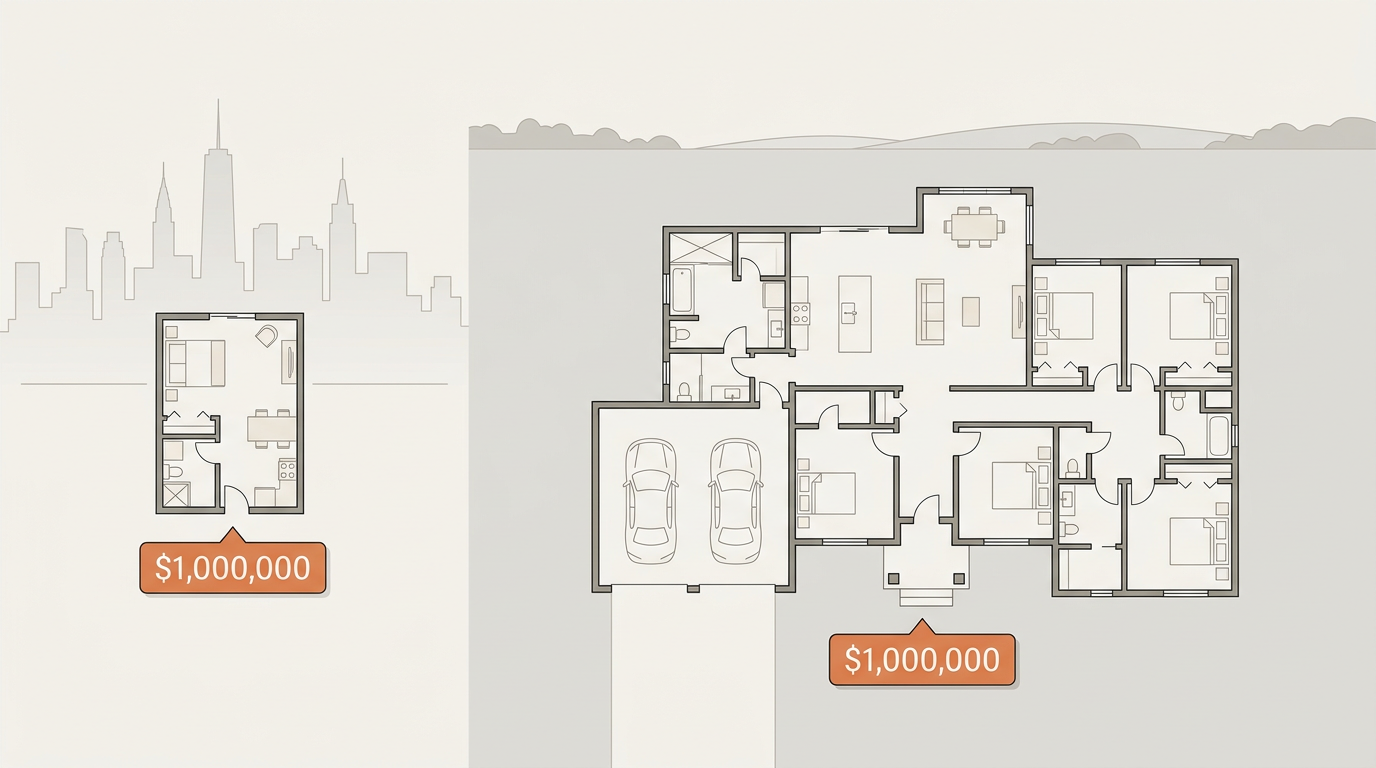
A million dollars in New York gets you about 670 square feet.
That's a one-bedroom. Maybe a junior one-bedroom with a flex wall the broker swears is "basically two." You'll have a kitchen you can touch all four walls of without moving your feet, and if the listing photos used a wide-angle lens, you already know why.
For most of the country, "millionaire" is still shorthand for arrived. In Manhattan it's the price of admission to a normal life in a small apartment. I find that gap fascinating, partly because I don't sell real estate. I build software for the people who do, which means I spend my days looking at this market from the outside, watching agents try to explain numbers that stopped making sense years ago.
So let's actually look at the numbers.
What $1,000,000 buys, borough by borough
Here's the same million dollars, spread across the city and then against the national average. The price-per-square-foot figures are rounded from recent Douglas Elliman (Miller Samuel) and StreetEasy data. The latest quarter will nudge them, but the shape of the picture doesn't move.
| Where | Rough price / sq ft | What $1,000,000 buys |
|---|---|---|
| Manhattan | ~$1,500 | ~670 sq ft. A one-bedroom. |
| Brooklyn | ~$1,000 | ~1,000 sq ft. A modest two-bed, if you're lucky on the block. |
| Queens | ~$725 | ~1,380 sq ft. A real two-bed, maybe a three. |
| The Bronx | ~$400 | ~2,500 sq ft. Space, finally. |
| US median (national) | ~$230 | ~4,300 sq ft. A five-bedroom house with a yard. |
Read that last row again. The exact same money that buys a one-bedroom in Manhattan buys a five-bedroom house with a lawn and a two-car garage across most of America. Not a nicer apartment. A different category of human life.
The national median existing-home price is sitting around $420,000, per the National Association of Realtors. So in much of the country, a million dollars doesn't just buy a house. It buys a house and most of a second one.
The number that should stop you
Manhattan's median sale price has hovered near $1.1 to $1.2 million for years now. Not the luxury tier. The median. That means half of everything that sells in Manhattan goes for more than a million dollars.
Renting doesn't rescue you either. Manhattan's median rent has been smashing records, pushing past $4,000 a month and staying there. That's $48,000 a year, after tax, for the privilege of not building any equity. A household would need to clear well into six figures just to follow the old rule of keeping rent under a third of income, and most don't.
Why this matters if you've never sold a thing in New York
Here's the part that surprised me when I started paying attention.
The expensive city sets a reference price, and everyone else's buyers carry it with them like a currency.
The New York price chart isn't really a New York story. It's the engine behind half the deals happening in Austin, Tampa, Phoenix, Charlotte, and Nashville. When a software engineer in Brooklyn does the math above, sees that her $1M buys a one-bedroom at home or a five-bedroom in Raleigh, and starts packing, she becomes someone else's buyer. An agent two thousand miles away gets a client who already feels rich the moment they land, because relative to where they came from, they are.
This migration has been one of the largest internal movements of money and people in the country. The Sunbelt boom that reshaped entire metros over the last few years was built, in large part, on people fleeing exactly the math in that table. So when you read that Austin or Miami had a wild run, understand what was pushing it. It was New York's price per square foot, working at a distance.
And it cuts the other way too. When New York wobbles, when finance bonuses shrink or a shock freezes the high end, that ripple reaches the agent in Florida who never once thought of themselves as exposed to Manhattan. The map is more connected than it looks.
The real takeaway
A million dollars is no longer a finish line. In New York it's a starting bid, and in most of the country it's a flex you'll never fully spend. That single contrast, 670 square feet versus 4,300, is the most honest summary of the American housing market I can give you.
If you sell homes, the lesson isn't to memorize Manhattan's price per square foot. It's to understand the gravity it creates. Your next out-of-state buyer isn't moving because they read a market report. They're moving because they did the same arithmetic you just did, felt the same small jolt, and decided their million should buy a life instead of a hallway.
Watch where the expensive cities push people. That's usually where the next deal is already walking toward you.